
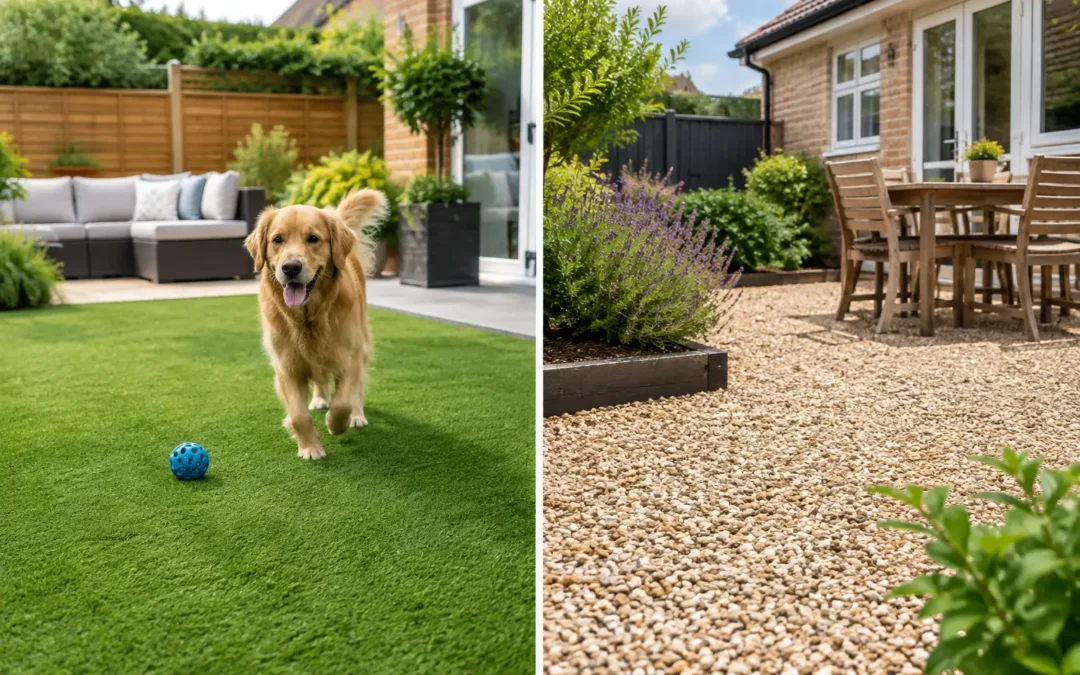
A garden that turns into muddy paw prints and gravel scattered across the patio soon stops being relaxing. When weighing up dog turf versus gravel, most homeowners are looking for the same things: a surface their dog can use comfortably, less mess brought indoors, and a garden that still looks tidy after a wet Nottinghamshire winter.
Both options can work in the right setting, but they feel very different underfoot and need different levels of care. The best choice depends on your dog, how often the garden is used, the condition of the ground underneath and whether the area is mainly a toilet spot, a run-around space or part of the family garden.
Dog turf versus gravel: the day-to-day difference
Gravel is often chosen because it is quick to lay and rain can pass through it. It can suit a narrow side return, a small utility area or a section of garden where appearance is not the main priority. However, dogs do not always find it comfortable, particularly if the stones are sharp, loose or uneven. Gravel also moves. Energetic dogs can kick it into borders, across paving and into the house, while regular use can leave dips and bare patches in the base.
Artificial grass gives a softer, more lawn-like finish. A good dog-suitable grass can provide a comfortable place for dogs to walk, sit and play, as well as somewhere children can use without loose stones underfoot. It also keeps the garden looking green without the repeated mowing, re-seeding and muddy areas associated with a natural lawn that struggles under paws.
That does not mean artificial grass needs no care. Dog waste still needs picking up promptly, and the surface should be rinsed and brushed as part of normal garden maintenance. The difference is that cleaning is usually more straightforward when the grass has been selected and installed properly.
Comfort matters more than many owners expect
Gravel can be perfectly acceptable for some dogs, especially as a route through the garden rather than their main outdoor area. Yet it is worth considering the size, age and habits of your dog. Small dogs may find larger stones awkward to walk on. Older dogs may prefer a stable, softer surface. Dogs that like to lie in the garden are generally more likely to settle on artificial grass than on loose gravel.
There is also the practical question of paws. Stones can lodge between pads, and sharp-edged aggregate is not a good choice for a garden used regularly by dogs. Smooth, rounded gravel reduces that issue, but it can still travel. If your dog enjoys digging, gravel can be especially frustrating to contain.
Artificial grass is not identical to natural grass, but it offers a more even and forgiving surface. For households where the dog uses the garden every day and the family wants to enjoy the same space, that often makes it the more practical option.
Drainage is about what lies beneath
It is easy to assume gravel always drains well and artificial grass does not. In reality, drainage depends mainly on the ground preparation and the soil conditions below the finished surface.
Gravel allows water through the gaps between stones, but if it sits over compacted ground or heavy clay, water still has nowhere to go quickly. The result can be puddling, saturated soil and a damp, unpleasant area beneath the gravel.
The same principle applies to artificial grass. Quality grass has a permeable backing that allows water to pass through, but it needs a correctly prepared, level and free-draining base. Where required, this involves removing existing turf and unsuitable material, installing a compacted Type 1 roadstone sub-base, using the appropriate finishing layer and allowing for drainage across the area.
This preparation is one reason a professionally installed dog lawn can look and perform very differently from grass simply laid over an existing surface. A neat finish is important, but getting the base right is what helps prevent movement, standing water and uneven areas over time.
Gardens in Nottinghamshire and Derbyshire can vary greatly, even within the same town. Heavy clay, shaded gardens and low spots all need to be assessed before deciding whether turf or gravel is suitable. A site survey is useful because it considers the garden you actually have, rather than relying on a one-size-fits-all answer.
Cleaning up after dogs
For solid waste, both gravel and artificial grass need prompt clearing. With gravel, the job can be more awkward because waste can fall between stones or stick to loose material. Removing it without taking gravel away at the same time is not always easy, particularly after rain.
On artificial grass, waste usually remains on the surface and can be lifted with a scoop or bag. A regular hose-down helps keep the area fresh, while brushing the pile occasionally removes leaves and keeps the fibres looking more natural. If urine odour becomes noticeable, particularly in a small garden with more than one dog, a suitable artificial grass cleaner can help as part of a regular cleaning routine.
No surface can promise to be completely odour-free. The key is to choose a permeable grass, ensure good drainage and keep on top of cleaning. Larger dogs, multiple dogs and compact gardens all place greater demands on the surface, so they should influence the grass and installation specification from the start.
Appearance and garden use
Gravel creates a practical, informal look, but it can make a garden feel harder and less inviting when used across a large area. It may suit a decorative strip, path or planting scheme, particularly alongside paving. For a full garden surface, though, it is rarely the first choice for families who want somewhere to sit out, play or let the dog spend time comfortably.
Artificial grass tends to work best where the garden needs to do more than one job. It can give a consistent green finish around patios, garden furniture and play areas, while helping to reduce mud near doors and pathways. For homeowners tired of patchy natural turf caused by shade, moss, repeated dog use or poor drainage, it can be a sensible alternative.
There are different pile heights and grass styles to consider. A very soft, luxurious-looking grass may be ideal for a low-use ornamental area, but a dog-owning household may be better served by a durable, practical product that drains well and is easier to brush and clean. Seeing samples in your own garden makes this decision much easier, as colour, feel and pile density can look different outdoors.
Cost and upkeep: think beyond the first installation
Gravel can have a lower initial cost for a simple area, particularly when the ground is already stable and level. However, it may need topping up, raking back into place and weeding if the membrane or base is not performing well. Loose stones can also end up in drains, on paving and in indoor spaces.
Artificial grass usually involves more preparation at the start, especially where excavation, drainage improvements or a new base are required. Once installed properly, the ongoing work is generally light: remove waste, rinse when needed, clear leaves and brush the surface from time to time. There is no mowing, no muddy lawn to re-seed and no need to wait for natural grass to recover after a wet spell.
The right choice is not always the cheapest one on day one. It is the surface that suits how your household uses the garden and remains manageable over the years.
When gravel may still be the better choice
Gravel has a place in dog-friendly gardens. It can work well for a short access path, a drainage strip beside a building, or a separate area where a dog only passes through. Some owners also prefer it for a contained toilet area, provided the stones are suitable, the base drains properly and they are happy with the cleaning routine.
It is less suitable as the main dog space where comfort, play and a clean finish matter. If your dog spends a lot of time outdoors, races around the garden or regularly comes back into the house through the same door, artificial grass is usually the more comfortable and contained option.
A good starting point is to think about your dog’s routine, not just the look of the material. Fabgrass can assess the ground, show you dog-suitable samples and give straightforward advice on whether artificial grass is the right fit for your garden. A free home visit can often answer questions that are difficult to judge from photographs alone.

